

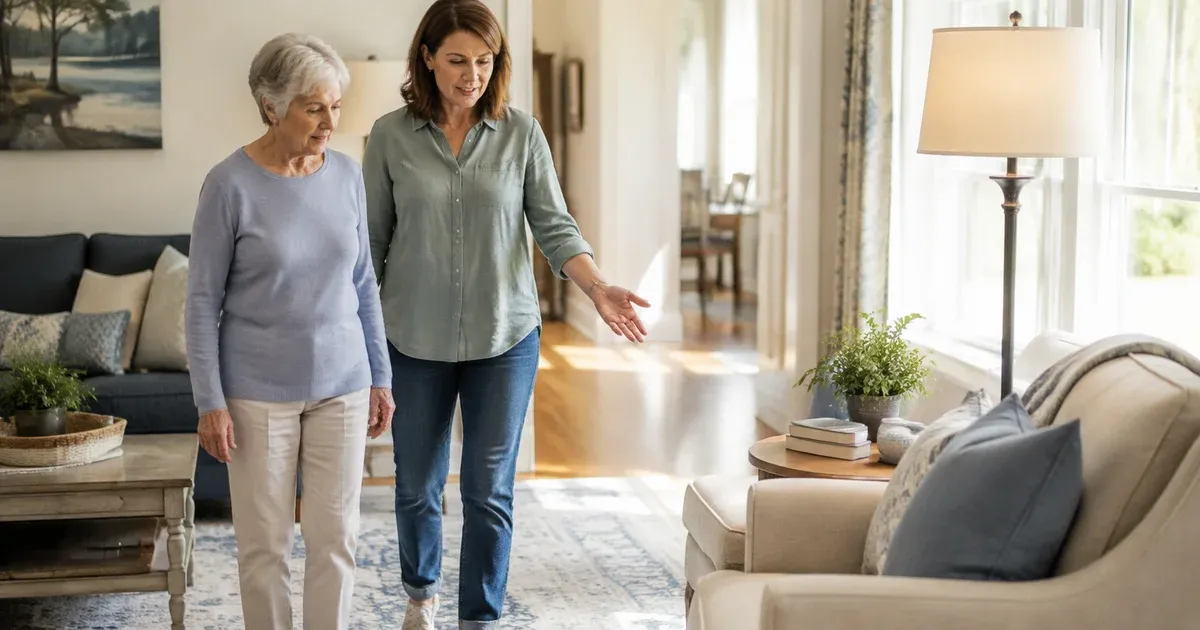
Falls are common, but they are not an unavoidable part of getting older. Kansas City families can start with two coordinated steps: ask a healthcare professional about the older adult’s personal fall risk, and walk through the home together to find practical hazards.
This guide provides a room-by-room checklist for that conversation. It does not replace a professional assessment, and no checklist or care service can eliminate every fall.
The timing is especially relevant this month. The National Council on Aging has designated September 21–25 as Falls Prevention Awareness Week 2026. Mid-America Regional Council also lists a free Kansas City A Matter of Balance class beginning September 8. Details about that class were checked on September 3, 2026, and should be confirmed with the organizer before attending.
In this guide
- Start with the older adult’s priorities
- Complete a room-by-room home safety check
- Discuss health and medication factors
- Make a plan for a fall
- Find Kansas City and Missouri resources
- Understand how non-medical care may fit
Start with the older adult’s priorities
A home-safety conversation works best when it is done with an older adult, not to them. Begin by asking where they feel least steady, which routes they use at night, and what changes they would find acceptable.
Avoid turning the walkthrough into an inspection of everything the person is doing “wrong.” A favorite rug, a dim evening routine, or furniture arranged for years may carry practical or emotional importance. Explain the concern, listen to the person’s preference, and look for a solution together.
If the family has noticed a new change—such as dizziness, weakness, confusion, difficulty walking, or a recent fall—contact an appropriate healthcare professional. A sudden or severe symptom may require urgent care. Call 911 for an emergency.
Complete a room-by-room home safety check
Use the routes the person actually travels. Start outside, walk through the main living spaces, and finish with the path between the bed and bathroom. Try the walkthrough during the day and after dark because lighting conditions can reveal different problems.
Entrances and outdoor walkways
- Look for uneven pavement, loose gravel, leaves, hoses, or cords across the route.
- Check whether steps and changes in level are easy to see.
- Confirm that exterior lights illuminate the lock, threshold, steps, and walkway.
- Make sure frequently used railings feel stable.
- Decide how snow, ice, and wet leaves will be handled before colder weather arrives.
- Keep packages, shoes, and seasonal decorations out of the normal walking path.
Kansas City weather can change quickly in fall. A plan for clearing leaves and dealing with wet or icy surfaces is more useful when responsibilities are assigned before bad weather arrives.
Stairs and hallways
The CDC recommends handrails on both sides of stairs, good lighting, and keeping floors free of objects that could cause a trip.
- Remove boxes, shoes, pet toys, and electrical cords from the route.
- Replace burned-out bulbs and make switches accessible at both ends of a passage when possible.
- Check that stair edges are visible and floor coverings lie flat.
- Avoid carrying a load that blocks the person’s view of the steps.
- Ask a qualified professional to repair loose steps, flooring, or railings.
Do not improvise a weight-bearing grab surface. Towel bars, furniture, and decorative trim may not support a person safely.
Living room
- Create a wide, direct route between the person’s usual chair, doorway, phone, and bathroom.
- Move low tables, footstools, plant stands, and cords away from that route.
- Remove loose rugs or secure them so they cannot slide or curl.
- Check whether chairs are stable and practical for the person to get into and out of.
- Keep commonly used items within comfortable reach to reduce stretching or climbing.
- Notice whether a pet frequently moves through the person’s feet.
The goal is not an empty room. It is a familiar room with predictable walking paths and fewer surprises underfoot.
Bedroom and nighttime route
- Place a lamp or reachable light control near the bed.
- Use nightlights between the bed and bathroom.
- Keep phones, glasses, and other nighttime necessities within easy reach.
- Make sure blankets, clothing, cords, and footwear stay off the floor.
- Avoid relying on unstable furniture for support.
- Check whether the route changes when a closet or bathroom door is open.
If the person gets up frequently at night or feels dizzy when standing, share that information with a healthcare professional rather than treating it only as a lighting problem.
Bathroom
Bathrooms combine hard surfaces, water, and changes in position. The CDC recommends grab bars inside and next to the tub or shower and beside the toilet.
- Use properly installed grab bars where a qualified professional recommends them.
- Check for water that collects on the floor.
- Use a secure, non-slip surface in the tub or shower.
- Keep towels and toiletries within easy reach.
- Improve nighttime lighting leading into and inside the bathroom.
- Ask an occupational therapist or another qualified professional whether additional equipment or changes would suit the individual.
A suction-cup device or towel rack should not automatically be treated as a structural grab bar. Installation and product choice matter.
Kitchen and dining area
- Store everyday dishes, food, and appliances between waist and shoulder height when practical.
- Avoid chairs, stools, or boxes as climbing aids.
- Clean spills promptly and address flooring that lifts or shifts.
- Keep the route between food preparation, table, and sink clear.
- Use enough light to see spills, edges, and objects on the floor.
- Sit for tasks when that approach has been recommended and works safely for the person.
Discuss health and medication factors
Removing a loose rug is useful, but fall risk is not only about the home. The CDC recommends that older adults discuss fall risk with a healthcare provider, review medicines that may cause dizziness or sleepiness, have their eyes checked at least yearly, and participate in activities that improve strength and balance when appropriate.
Write down questions before the next appointment:
- Has the person fallen, nearly fallen, or begun holding walls or furniture?
- Do they feel dizzy, unsteady, unusually tired, or lightheaded?
- Have medications or doses changed recently?
- Is vision or hearing making the environment harder to interpret?
- Are shoes supportive and appropriate for the surfaces in the home?
- Which strength or balance activities are safe for this individual?
- Would a physical therapist, occupational therapist, pharmacist, vision professional, or hearing professional add useful expertise?
Do not stop or change a medication based on a general checklist. Bring every prescription, over-the-counter medicine, and supplement to the attention of the relevant healthcare or pharmacy professional.
Make a plan for a fall
Prevention matters, but families also need a response plan. Decide how the person will call for help, who should be contacted, and how responders can enter the home if the person cannot reach the door.
Keep emergency information current and easy to find. Include the person’s address, emergency contacts, medications, allergies, healthcare contacts, and any advance-care documents the family has chosen to maintain.
If a fall occurs, avoid assuming the person is uninjured simply because they want to get up. Follow the instructions of emergency or healthcare professionals. Call 911 for an emergency, including serious injury, severe pain, loss of consciousness, new confusion, difficulty breathing, or symptoms that could indicate a stroke. When uncertain about the appropriate response, contact a qualified medical professional.
Tell the person’s healthcare provider about a fall or meaningful change in balance. Understanding what happened may reveal a medical, medication, vision, mobility, or environmental factor that needs attention.
Find Kansas City and Missouri resources
A Matter of Balance in Kansas City
As of September 3, 2026, Mid-America Regional Council lists a free A Matter of Balance class running September 8 through October 27 at Kansas City Shepherd’s Center, 9200 Ward Parkway in Kansas City, Missouri. The eight-session program is designed to reduce fear of falling and increase activity among older adults.
MARC lists the class time as 9:30–11:30 a.m. and a registration contact of 816-293-9612. Contact the organizer to confirm space, eligibility, schedule, accessibility, and any changes before attending.
Missouri fall-prevention programs
The Missouri Department of Health and Senior Services lists evidence-based exercise and health programs for eligible Missourians age 60 and older, including programs focused on fall prevention. Availability varies by location.
Missouri’s Senior Resource Line at 1-800-235-5503 can route callers to the appropriate Area Agency on Aging using the older adult’s ZIP code. Ask about current programs, eligibility, cost, and location.
These organizations are independent resources and are not Blue River partners unless a formal relationship is explicitly stated.
Understand how non-medical care may fit
Home modifications and clinical fall-risk evaluations belong to qualified professionals. Non-medical companion care has a different role.
Depending on the agreed care plan, a companion visit may support:
- A calmer daily routine with less pressure to rush.
- Meal preparation and light household routines.
- Keeping agreed walking routes free of everyday clutter during a visit.
- Accompaniment for approved activities or errands.
- Conversation and social engagement.
- Communication of observed changes or concerns to the designated family contact.
Companion care cannot guarantee fall prevention, provide emergency response, diagnose a condition, prescribe exercise, review medications clinically, or replace skilled nursing, physical therapy, or occupational therapy. Our guide to home care versus home health care explains those different roles.
If fall concerns are appearing alongside harder meals, housekeeping, personal routines, loneliness, or family caregiver strain, review the signs it may be time to consider home care. Blue River offers companion care and in-home caregiving across listed communities on the Missouri side of the metro. Families can review local planning details for Kansas City, Missouri; every location and schedule remains subject to caregiver availability and travel distance.
The first conversation does not require the family to arrive with a finished plan. Schedule a free consultation or call 816-641-2881 to talk through which daily routines have changed and what kind of non-medical support your family wants to explore.
Frequently asked questions
What commonly causes older adults to fall at home?
Falls rarely have just one cause. Health changes, medication side effects, reduced strength or balance, vision problems, poor lighting, loose rugs, clutter, and missing handrails can combine. A healthcare professional can evaluate personal risk factors; families can also review the home for practical hazards.
How can families reduce an older adult's fall risk?
Begin with clear walking paths, secure rugs, better lighting, handrails on both sides of stairs, and properly installed bathroom grab bars. Ask a healthcare professional to review health risks, medications, vision, and appropriate strength or balance activities. No checklist can eliminate every fall.
Should throw rugs be removed from a senior's home?
A loose or curled rug can become a trip hazard. The CDC advises removing rugs or using double-sided tape so they do not slip. Consider the person's mobility, the floor beneath the rug, and guidance from a qualified home-safety professional.
Who can perform a professional fall-risk assessment?
Start with the older adult's physician or another qualified healthcare professional. Depending on the person's needs, the care team may involve physical therapy, occupational therapy, pharmacy, vision, or hearing professionals. Non-medical companion care does not replace a clinical fall-risk assessment.
Are fall-prevention classes available in Kansas City?
Yes, but schedules change. As of September 3, 2026, Mid-America Regional Council lists a free A Matter of Balance class at Kansas City Shepherd's Center from September 8 through October 27, 2026. Confirm space, eligibility, and current details directly with the organizer before attending.
Can companion care prevent falls?
Companion care cannot guarantee that a fall will not happen and does not provide a clinical assessment. Depending on the agreed care plan, non-medical support may help a person follow familiar routines, avoid rushing through daily tasks, and communicate changes or concerns to the designated family contact.
Sources
Blue River uses primary public sources so families can verify benefit, coverage, and care-planning information directly.
- Falls Prevention Awareness Week 2026 — National Council on Aging
- About Older Adult Fall Prevention — Centers for Disease Control and Prevention
- A Matter of Balance: September 8–October 27 — Mid-America Regional Council
- Evidence-Based Exercise and Health Programs — Missouri Department of Health and Senior Services